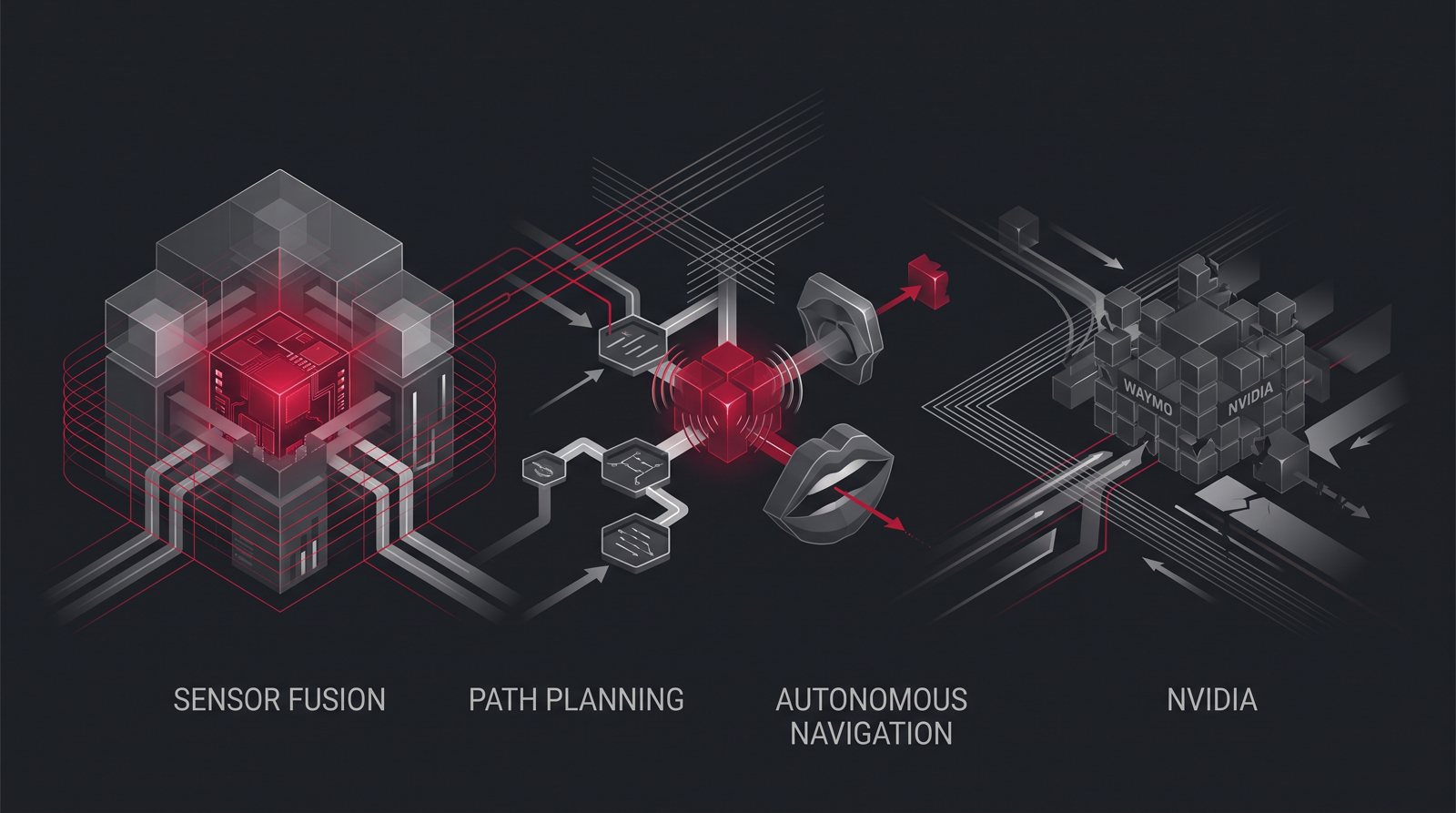
Waymo has built its own application-specific integrated circuit (ASIC) to power the perception, reaction-time, and navigation stack inside its robotaxis, a move that reduces how much the Alphabet-owned self-driving unit depends on Nvidia for onboard compute. According to Techmeme, the chip is designed to speed up how quickly the vehicles process sensor input and respond to what's happening on the road.
The detail worth sitting with here isn't the chip itself — it's who's making it. Waymo isn't a chipmaker, and until recently it didn't need to be one. GPUs from Nvidia have been the default substrate for almost every AI workload since the deep learning boom took off, robotics and autonomous driving included. A company building custom silicon for a task that's currently running fine on merchant hardware is a signal about cost, supply, and control — not just performance.
Why a robotaxi needs its own chip
Robotaxis are a specific kind of AI workload: the model has to ingest lidar, radar, and camera streams and produce a driving decision within a fixed latency budget, in a moving vehicle, with no cloud round-trip to fall back on. That's a narrower, more predictable job than training a frontier language model, which is exactly the kind of workload that benefits most from an ASIC — hardware built for one job runs it more efficiently than a general-purpose GPU built for thousands of jobs.
An in-house chip also gives Waymo three things a purchased GPU doesn't:
- Supply that isn't queued behind every other AI company's Nvidia order
- A cost structure that isn't tied to Nvidia's margins at fleet scale
- The ability to tune the chip specifically for driving-inference latency rather than general matrix-multiply throughput
Part of a broader shift away from Nvidia
Waymo isn't operating in isolation here. Tesla has spent years on Dojo and its Full Self-Driving inference chip, Amazon has Trainium and Inferentia, Microsoft has Maia, and Meta has its MTIA line — each one a bet that owning silicon for a well-defined, recurring workload pays for itself once volume is high enough. Alphabet, Waymo's parent, has run its own TPU program for close to a decade, so the institutional know-how for custom AI silicon already exists inside the company; it's reasonable to expect Waymo drew on that experience, though the story doesn't specify the relationship.
What's notable is the direction of travel: this is no longer a handful of hyperscalers hedging against GPU shortages. It's now companies whose core product is a physical vehicle, not a cloud service, deciding that the inference layer is important enough to own outright.
What this means if you're planning inference infrastructure
Most AI builders aren't going to tape out a chip. But Waymo's move is still a useful data point for anyone thinking past the next quarter's GPU bill:
- Custom silicon pays off at fixed, high-volume workloads. Waymo's driving-inference task doesn't change shape the way a chatbot's does — it's the same sensor-to-decision loop, over and over, at fleet scale. That's the profile where an ASIC beats a GPU on cost per inference.
- Nvidia dependency is now treated as a strategic risk, not just a budget line. Every company named above sits on Nvidia's largest-customer list and is still building an exit path. If you're locking in multi-year inference commitments, model that risk explicitly rather than assuming GPU pricing and availability stay flat.
- Vertical integration follows product maturity, not ambition. Waymo didn't build a chip on day one — it built one once the driving task was well enough understood to justify hardware that only does that task. Most teams are better served waiting for that clarity than chasing custom silicon early.
AiiN's takeaway
Waymo joining Tesla, Amazon, Microsoft, and Meta in building its own AI chip confirms that vertical integration into hardware is now the default trajectory for any company running AI inference at real scale, not a strategy reserved for cloud providers. For teams planning long-term inference infrastructure, the practical lesson isn't “build your own chip” — it's “don't assume Nvidia is the only line item in your five-year plan.” In our estimation, the more workload-specific and high-volume an AI product becomes, the more likely its owner ends up doing exactly what Waymo just did.