Adobe has added generative music, text-to-speech, and sound-effect tools to Firefly, extending its AI suite past the image and video generators it has shipped since 2023.
The update rounds out what Adobe now positions as a full-stack creative AI pipeline inside Firefly: still images, video clips, and — as of this week — the audio layer that ties a scene together. Until now, anyone building a video or ad campaign with Firefly still had to leave the ecosystem to license a soundtrack, record a voiceover, or source sound effects from a separate vendor.
According to SiliconANGLE AI, the expansion is meant to sharpen Adobe's position against a fast-growing field of dedicated generative-audio companies, a market that has matured quickly over the past two years as music, voice, and sound-effect generation turned into commercially viable products in their own right.
Closing the gap between modalities
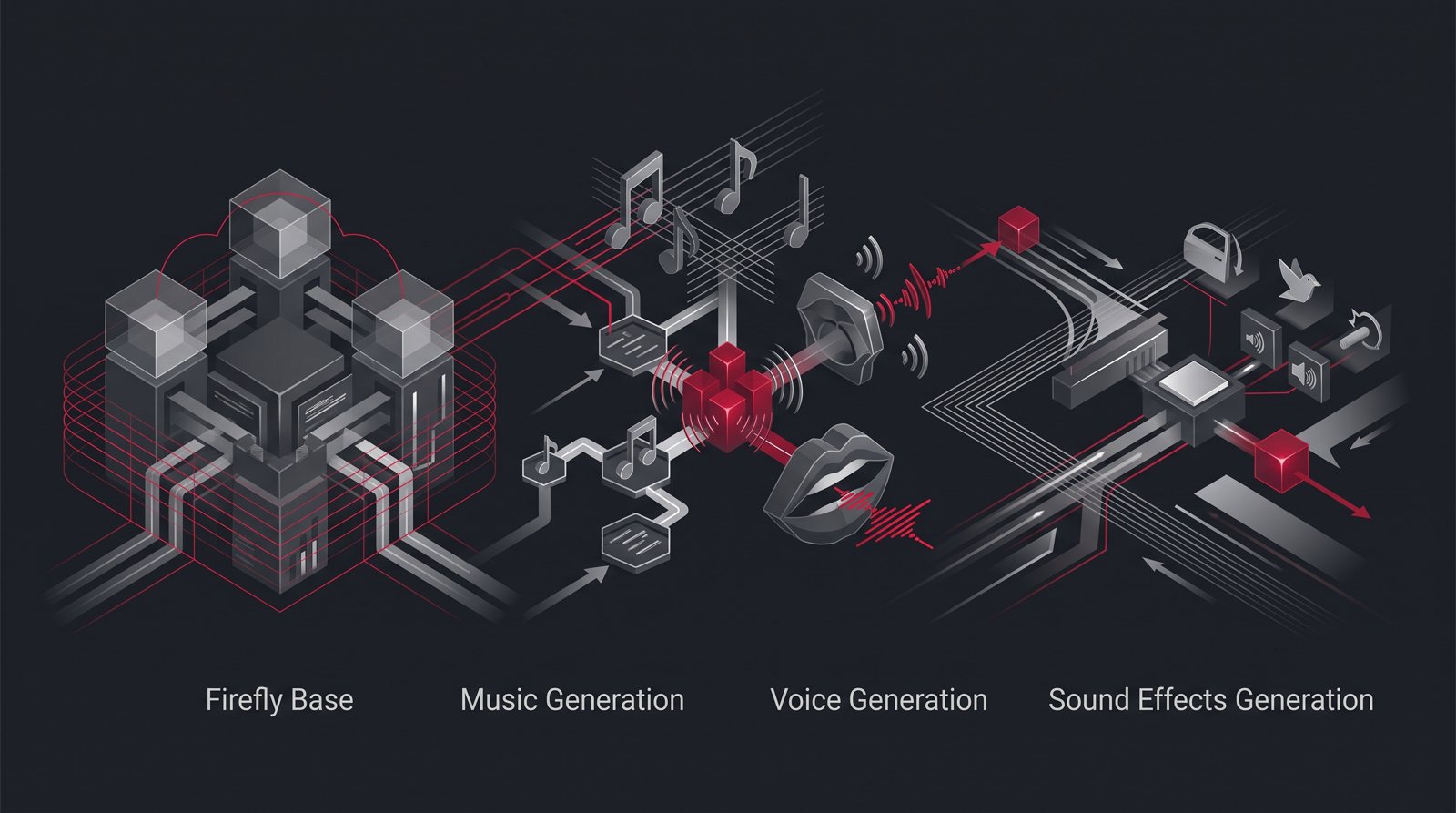
Firefly's capability list now spans nearly every asset type a media team touches in a single production:
- Image generation and editing (Firefly's original 2023 launch)
- Video generation and generative extend/fill
- Music generation
- Text-to-speech and speech generation
- Sound-effect generation
The point of bundling all five into one tool isn't novelty — it's removing the seams. A team producing a 30-second ad no longer needs a separate contract for the visuals, another for the voiceover, and a third for the score. Adobe is betting that collapsing that workflow into Creative Cloud, where Firefly already sits inside Premiere Pro, After Effects, and Express, is worth more than any single tool being best-in-class at one modality. It also lets Adobe market Firefly less as a set of individual generators and more as a single production surface — brief in, finished asset out.
Why the audio market just got more competitive
Generative audio has been one of the last multimedia categories dominated by specialists rather than the big creative-software platforms. Voice cloning and text-to-speech, AI-generated music, and synthetic sound design each grew into standalone product categories with their own funding, pricing, and developer ecosystems. Adobe folding all three into Firefly signals the same pattern that already played out in image generation: a category pioneered by focused startups gets absorbed into the feature set of a platform with existing distribution.
That doesn't erase the specialists' technical lead, but it does compress their pitch. "We can generate audio" stops being a differentiator once the capability ships by default inside software millions of people already pay for. For enterprise buyers already standardized on Adobe's ecosystem, that default availability alone can outweigh a modest quality gap with a standalone specialist.
What this means if you're building with generative media
For teams building AI-powered content products, the practical questions shift:
- Vendor consolidation gets easier to justify. Enterprise customers already on Creative Cloud gain music, speech, and sound-effect generation without procuring a new vendor or negotiating a separate usage-rights agreement.
- Licensing terms matter as much as output quality. Firefly has built its pitch around commercially cleared training data; in our estimation, that clearance is likely to carry more weight in enterprise audio deals than marginal gains in voice or music fidelity, since indemnification is the harder problem for legal teams to sign off on.
- The moat moves downstream. If your product's edge has been "we generate audio," that edge narrows every time a generalist platform ships the same capability as a checkbox feature. The more durable differentiation is in workflow integration, fine-grained control, and what happens after generation — not the base act of generating.
AiiN's takeaway
Adobe closing out the multimedia stack changes the competitive baseline for anyone building products around generated media: audio is no longer a category you need a specialist partner for by default. Teams evaluating build-vs-buy for voice, music, or sound-effect features should treat an all-in-one Firefly pipeline as the comparison point, not just point-solution APIs. The near-term effect is likely to show up first in ad agencies and in-house creative teams already running Firefly for images and video, since adding audio to an existing workflow costs less than adopting it standalone. Specialized audio startups will likely need to lean harder into developer-first tooling, licensing flexibility, and fine control that a consumer creative suite doesn't prioritize, because winning on raw generation quality alone gets harder against a bundled incumbent with existing distribution.