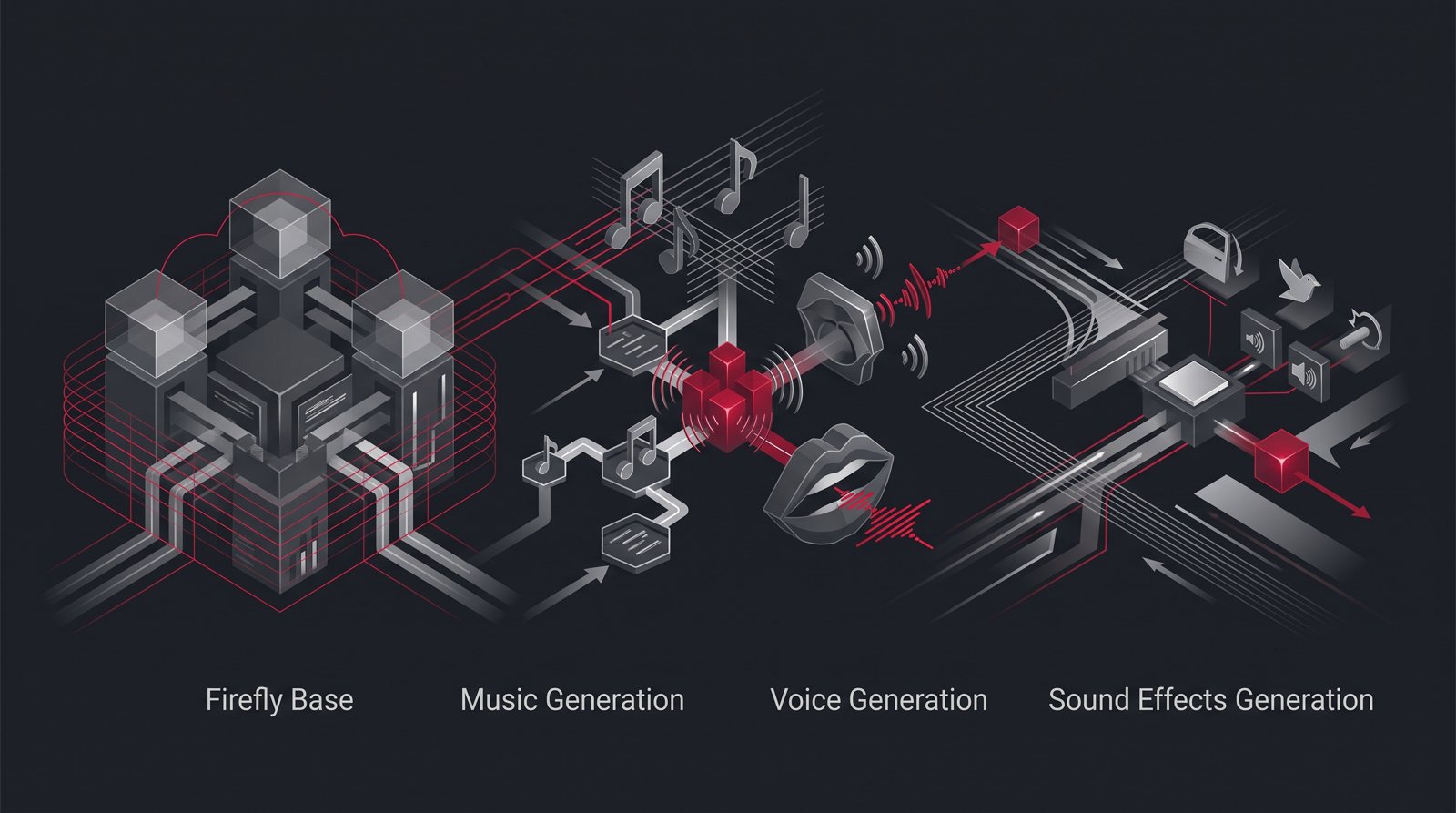
Adobe added AI-generated audio tools to Firefly this week, and Google shipped Gemini Omni Flash, a faster version of its multimodal model line, on the same day. According to The Decoder, the two moves land in the same window but come from different directions: Adobe is extending a creative suite that already handles images and video into sound, while Google is optimizing an existing multimodal model for speed rather than adding new capabilities.
Neither announcement is a breakthrough on its own. Audio generation inside a creative tool is a logical extension for Adobe, and a faster variant of an existing model is a routine move for any lab running a model family with multiple size tiers. What's notable is the pairing: one vendor adding a new modality to a production tool, another shipping a faster point on the latency curve for a model that already does several modalities. Together they describe where the market is actually moving — not toward flashier demos, but toward multimodal models that are cheap and fast enough to sit inside a real pipeline.
For teams building AI products, that shift changes which questions matter. Model quality leaderboards get attention, but they rarely answer the question that determines whether a feature ships: can this model respond fast enough, cheaply enough, and across enough input types to justify replacing three separate single-purpose models with one general one.
What shipped, and why it's not really about features
Firefly's new audio tools sit inside a product that Adobe has been steadily pushing from an image generator toward a full multimodal creative suite — first video, now sound. That's a product-roadmap story: Adobe is filling in a gap so creators don't have to leave Firefly to add a soundtrack or voiceover to something they built there.
Gemini Omni Flash is a different kind of story. Google isn't adding a modality — it's making an existing multimodal capability faster to run. Google's own naming convention uses Flash to mean a smaller, quicker, cheaper sibling to the flagship model, traded off against some raw capability. Applying that pattern to an Omni model — one built to handle text, image, and audio in a single pass — signals that Google sees latency, not just accuracy, as a variable worth optimizing on its multimodal line specifically.
Latency is the actual product decision
The practical reason this matters: multimodal quality and multimodal latency are usually in tension, and most production use cases care more about the second one than builders like to admit. A model that can reason brilliantly across audio, image, and text but takes several seconds per call is fine for a research demo and unusable for a voice assistant, a live customer-support widget, or a real-time video-editing suggestion.
Shipping a fast tier of a multimodal model is an admission that the flagship tier isn't the right default for most apps — it's the ceiling, not the baseline. In our estimation, more labs will follow this pattern over the next release cycle, since it's cheaper to ship a distilled fast variant than to solve the underlying latency problem at the flagship level.
What this means if you're building
- Benchmark on your actual latency budget, not the leaderboard. A model that wins on quality benchmarks but misses your response-time target is the wrong model for a live product, whatever its accuracy score says.
- Multimodal input handling is becoming table stakes, not a differentiator. If a fast, cheap model can take audio, image, and text in one call, routing logic that stitches together separate single-modality models is now overhead you may not need.
- Creative tooling is consolidating. Firefly adding audio follows a pattern seen across the industry: single-suite tools absorbing what used to require a separate specialized app, which changes the build-vs-buy calculus for anyone building adjacent tooling.
- Watch the fast tier, not just the flagship. Release notes for flagship models get the attention; the fast or distilled sibling is usually the one that actually ships in production apps.
AiiN's takeaway
Neither Adobe's audio tools nor Gemini Omni Flash are individually dramatic upgrades. What they show together is that the frontier for multimodal AI is splitting into two separate races: one for raw capability, and one for making that capability fast and cheap enough to actually deploy. For builders, the second race is usually the one that determines what ships this quarter — and it's worth tracking release notes for fast, flash, or mini variants as closely as you track the flagship announcements.