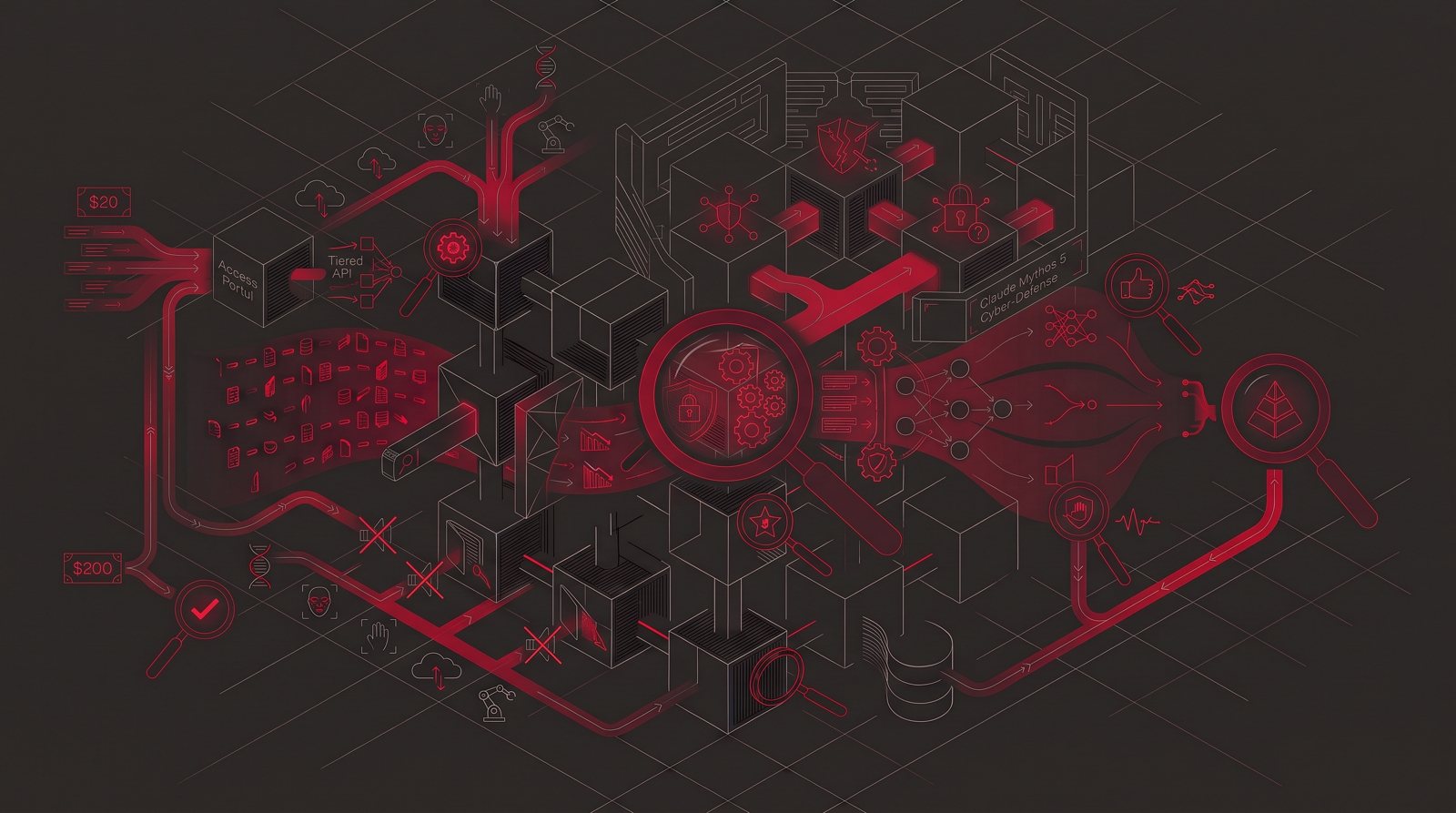
Anthropic has assigned Claude Mythos 5, its most powerful model to date, to a new kind of job: hunting for vulnerabilities and helping defend systems against cyberattacks, rather than just answering prompts in a chat interface.
That's a meaningful shift in framing. Frontier labs have spent the past two years pitching their top-tier models mainly as reasoning engines for coding, writing, and research. Putting the flagship model to work on security operations signals that Anthropic sees defensive cybersecurity as a task worth its best available capability, not a secondary use case handled by a smaller, cheaper model.
According to The Decoder, the deployment centers on two capabilities: identifying vulnerabilities before they can be exploited, and countering active attacks. Both are areas where large language models have shown promise for a while — but assigning the top model in the lineup, rather than a distilled or cheaper variant, is the notable part of this move.
Why the most capable model, specifically
Vulnerability discovery and incident response are workloads where marginal model quality tends to matter more than in typical chat use. A weaker model misses subtle logic flaws in code, misreads attacker behavior in logs, or produces false positives that erode analyst trust. Security teams that have experimented with LLM-assisted triage know the difference between a model that flags real issues and one that floods a queue with noise is often the deciding factor in whether the tool gets used at all.
Running the largest model against this class of problem also plays to a strength of frontier systems: reasoning over long, messy context — a sprawling codebase, a chain of log entries, a multi-step exploit — rather than answering a single, self-contained question.
From chat assistant to active security tool
The bigger story here is the category shift. A chatbot answers questions when asked. A cyber defense tool needs to operate continuously, correlate signals, and in some cases act — flagging or blocking behavior without a human typing a fresh prompt each time. Putting Claude Mythos 5 into that role treats the model less like an assistant and more like a piece of infrastructure integrated into a security pipeline.
This mirrors a pattern showing up across the industry: coding assistants evolving into autonomous agents that open pull requests, and now, apparently, frontier chat models being pointed at defensive security work that has traditionally required specialized, narrowly trained tools.
What this means for AI builders and security teams
For teams building on top of Claude or evaluating LLMs for security use cases, a few practical takeaways follow from Anthropic's own choice to use its top-tier model internally:
- Model tier matters for high-stakes detection work. If a vendor trusts its flagship model with its own defenses, that's a signal worth weighing when picking a model tier for vulnerability scanning or anomaly detection in your own stack.
- Expect LLM output to sit alongside, not replace, existing tooling. Vulnerability detection and attack response already rely on static analyzers, SIEM rules, and threat-intel feeds; an LLM's value is in reasoning across that output, not substituting for it.
- False positives remain the practical bottleneck. Any team piloting LLM-assisted security monitoring should budget as much effort for tuning alert quality as for the initial integration.
- Dogfooding is a credibility signal, not proof of generalization. Anthropic using its own model on its own infrastructure says less about how the model performs on a different company's stack, with different logging conventions and threat models.
AiiN's takeaway
The interesting part of this story isn't that an LLM can spot a vulnerability — that's been demonstrated by multiple labs and independent researchers already. It's that Anthropic chose to route this work through its most expensive, most capable model rather than a lighter one, which is effectively a statement about where the company thinks model capability creates the most defensive value right now. In our estimation, that likely reflects how unevenly current models perform on adversarial, high-context security tasks compared to routine coding or writing work — the gap between "good enough" and "actually useful" is wider here, and only the top-tier model closes it reliably enough to trust. For builders, the practical lesson is to treat security-adjacent LLM tasks as a case where it's worth testing the most capable model available before assuming a cheaper one will do.