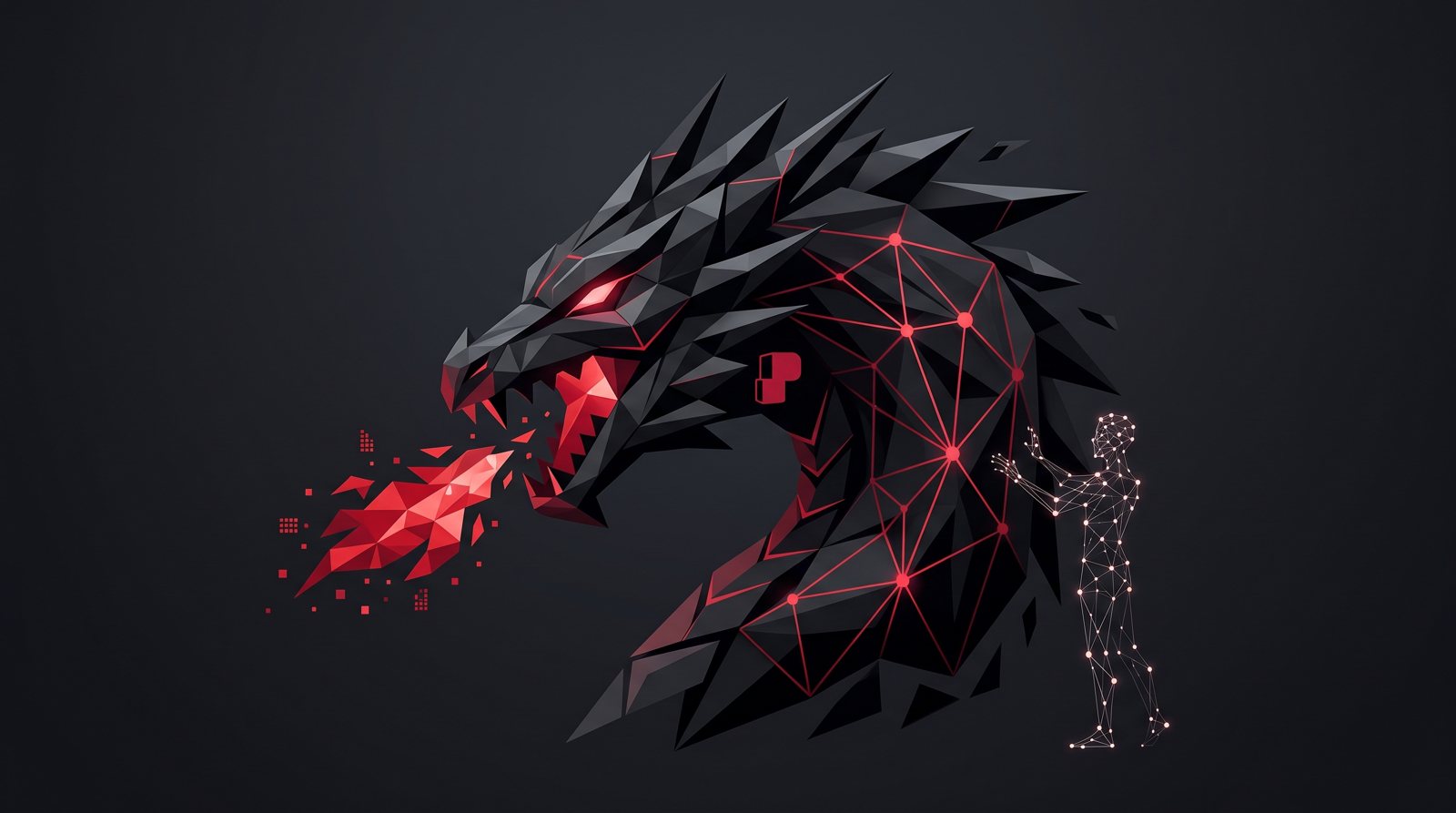
Platformer's newest essay takes aim at Mark Zuckerberg's AI manifesto with an unusual visual: superintelligence as a dragon — immensely powerful, potentially catastrophic, and not something any single company or founder can fully tame. The comparison isn't decorative. It's a direct challenge to the framing that dominates most corporate AI messaging, where advanced systems are described as tools, assistants, or platforms waiting to be shipped.
A dragon, unlike a product, doesn't come with a changelog or a kill switch you can trust. It can be raised, fed, and directed — but its power scales independently of anyone's ability to steer it. According to Platformer, that's precisely the tension in how Zuckerberg and other AI leaders talk about superintelligence: enthusiastic about the upside, vague about who actually holds the reins once the system is powerful enough to matter.
For an industry that spends most of its marketing budget on reassurance, that's a notably uncomfortable metaphor to sit with.
Why the dragon metaphor lands
The value of the comparison is that it separates two questions that get routinely conflated in AI manifestos: whether a technology is powerful, and whether it is controlled. A dragon can be both magnificent and lethal at the same time, and neither trait cancels the other out. Applied to superintelligence, the metaphor pushes back on the assumption — implicit in a lot of industry roadmaps — that capability and safety scale together, or that shipping fast is itself a form of risk management.
Platformer's essay treats control as a separate, harder problem than raw capability: an organization can be extremely good at building powerful systems and still have no reliable answer for what happens when those systems act in ways nobody predicted.
The control problem, not the capability problem
What makes this relevant beyond media commentary is that it reframes the debate away from "how smart can the model get" and toward "who is accountable when it does something we didn't intend." That's a governance question, not a benchmark question, and it doesn't have a clean technical answer yet. Few labs — including the ones publishing manifestos about the future of superintelligence — have published concrete, auditable mechanisms for the moment a system's behavior diverges from its stated purpose.
That gap matters because it currently gets closed with rhetoric rather than testing. Confidence and control are being talked about as if they scale together, when the essay's whole argument is that they don't.
What it means for people actually building AI products
None of this is abstract for teams shipping AI features today. The dragon framing is a useful stress test for products long before they get anywhere near "superintelligent":
- Treat autonomy and oversight as separate line items — more capability in a model doesn't automatically buy you more predictability, so budget for monitoring separately from budget for features.
- Build in a real kill switch, not a cosmetic one — the ability to fully halt an agent's actions, not just pause its next output, tested under load and not just in a demo.
- Assume the gap between "what we intended" and "what shipped" grows with scale, and put review checkpoints where that gap is most likely to appear — permissions, tool access, and multi-step autonomous workflows.
- Be skeptical of vendor manifestos that describe control in aspirational terms rather than specific mechanisms — ask what happens on day one if the system misbehaves, not what the roadmap says about year three.
These aren't hypothetical concerns reserved for frontier labs. Any team giving an AI agent write access to a database, a codebase, or a customer-facing channel is running a smaller-scale version of the same control problem the essay describes.
AiiN's takeaway
The dragon metaphor is memorable because it's honest about a tradeoff the industry usually smooths over: power and control are not the same axis, and optimizing for one doesn't guarantee the other. For builders, the practical lesson isn't to be afraid of AI — it's to stop assuming that a more capable system is automatically a safer or more predictable one. In our estimation, the teams that treat control mechanisms as core infrastructure, rather than an afterthought bolted on before a launch, will be the ones still standing when today's "impressive demo" becomes tomorrow's production incident.