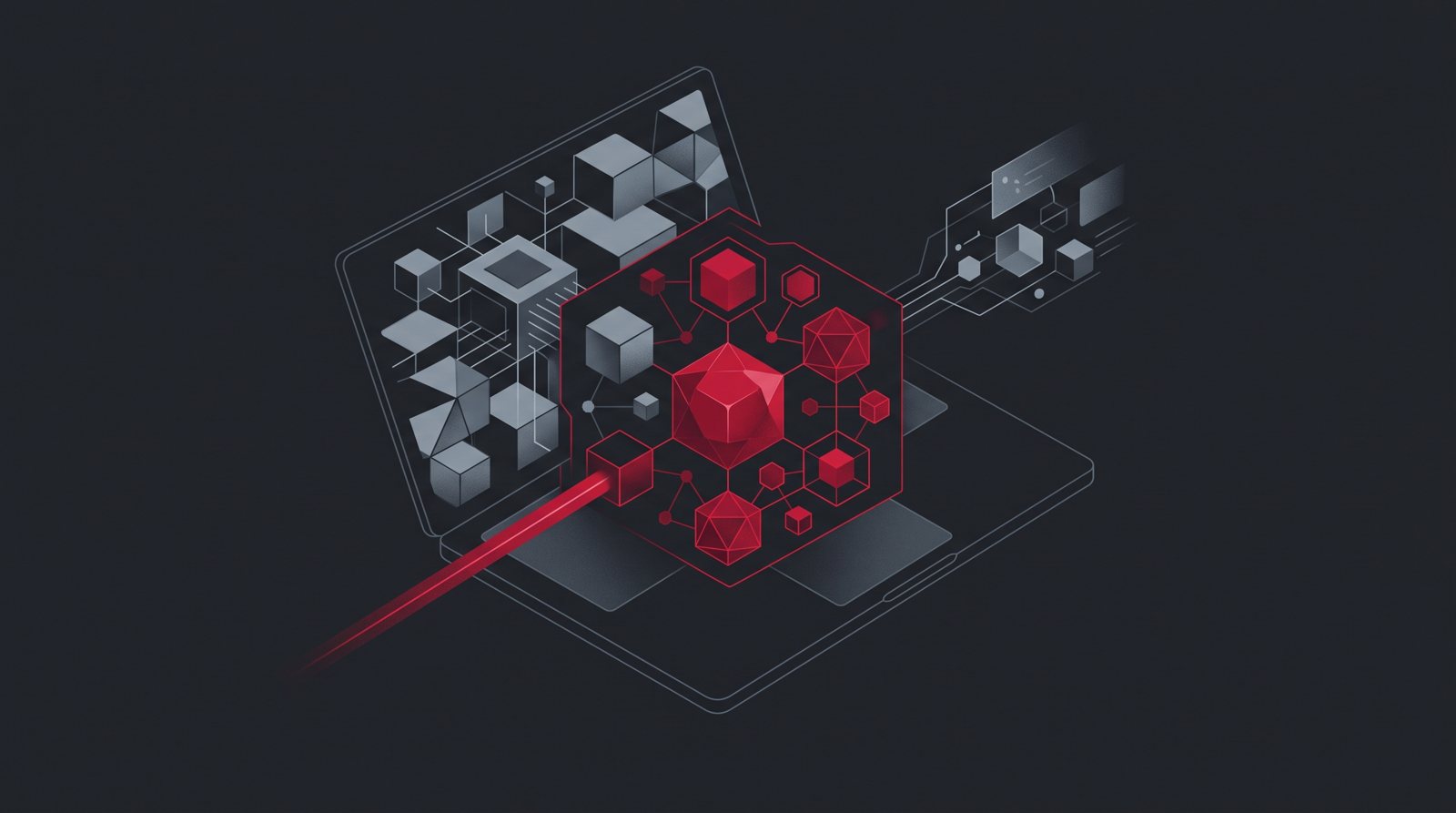
Microsoft's Copilot+ PC specification, introduced in May 2024, set a hardware bar of 40 trillion operations per second (TOPS) for a laptop's neural processing unit — turning what used to be a niche chip into a checkbox every major PC maker now has to hit. Intel's Core Ultra 200V series, AMD's Ryzen AI 300 chips, and Qualcomm's Snapdragon X Elite all now ship with a dedicated NPU sitting alongside the CPU and GPU, purpose-built to run AI workloads locally instead of routing them to a cloud API.
The debate over whether laptops need this separate silicon at all is, at this point, mostly settled among chipmakers — the real question is what software actually uses it. According to Speka, laptop makers are looking more seriously at dedicated AI chips as a distinct step in how the industry builds AI-capable hardware, and the outlet frames it as something AI developers specifically should be tracking rather than a spec-sheet footnote.
Why a separate chip, not just a faster CPU
A CPU is built for sequential, general-purpose logic; a GPU is built for parallel graphics math that turns out to also suit matrix multiplication. Neither is efficient at the specific pattern that dominates AI inference — repeated, low-precision matrix operations run continuously. An NPU is silicon shaped around exactly that pattern, and the payoff is efficiency, not raw speed: running a small model on an NPU can use a fraction of the power a GPU would burn on the same task, which matters enormously on a device with a fixed battery.
That efficiency argument is why the chip lives inside the laptop rather than being left to a cloud GPU. Cloud inference is fast and scales well, but it costs money per call, adds network latency, and sends user data off the device. A local NPU flips that trade-off: slower per-token throughput than a data-center GPU, but free per call, no round trip, and everything stays on the machine.
What actually runs on it today
- Background tasks: live captioning and translation, webcam background blur and eye contact correction, noise suppression on calls
- OS-level features: Windows Recall-style semantic search, Copilot's local components, on-device summarization
- Small local models: quantized 1–3B parameter models for autocomplete, simple RAG, and lightweight agents that don't need frontier-model reasoning
What doesn't run on an NPU yet, in practice, is anything resembling a frontier model. A 40-TOPS chip can comfortably handle a small quantized model but has nowhere near the memory bandwidth or compute for a GPT-4-class or Claude-class model — those workloads still go to the cloud, NPU or not.
What it means for developers building on top
For teams building AI features into desktop or laptop software, the practical shift is architectural: instead of assuming every inference call hits an API, it becomes worth asking which parts of a workflow can run locally on the NPU and which genuinely need a large model in the cloud. Frameworks like ONNX Runtime, DirectML, and Apple's Core ML already let developers target NPUs directly, and the hybrid pattern — small model on-device for latency-sensitive or privacy-sensitive steps, large model in the cloud for reasoning-heavy steps — is becoming a standard design choice rather than an edge case.
In our estimation, the more concrete effect over the next product cycle is on cost and privacy-sensitive use cases: features that would be too expensive to run per-call in the cloud at scale — real-time transcription, on-device search, always-on assistants — become viable once the inference cost is a one-time hardware cost baked into the laptop instead of a recurring API bill.
AiiN's takeaway
The dedicated AI chip isn't a marketing gimmick tacked onto a laptop spec sheet — it's a response to a real cost and latency problem that shows up the moment AI features move from demo to product. For builders, the useful move now is to treat the NPU as a target platform worth testing against, not just a checkbox to note in a press release, especially for any feature where per-call cloud costs or data privacy make local inference the better trade.