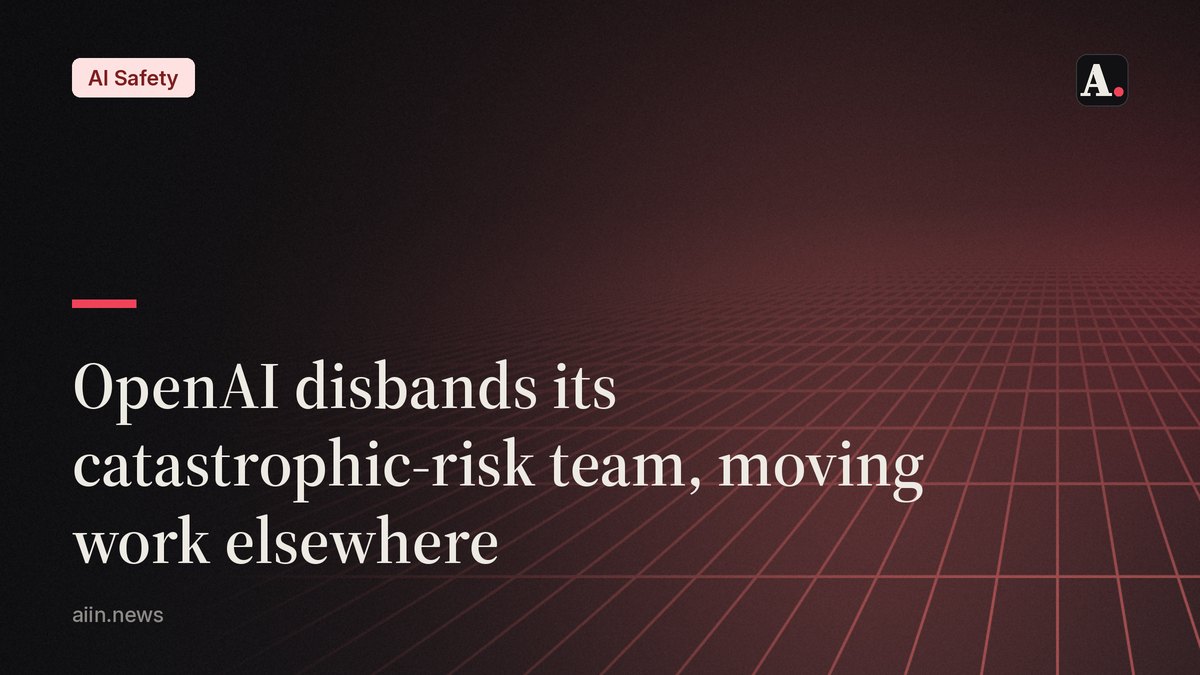
OpenAI has dissolved the internal team it built specifically to catch catastrophic risks from its own models, reassigning its responsibilities to other groups inside the company. According to The Decoder, the unit that once had a standalone mandate to flag cyber, biological, chemical, and autonomy-related dangers before they shipped no longer exists as a separate function.
That mandate was not a minor internal committee. It sat at the center of OpenAI's Preparedness Framework, the public document the company uses to explain how it decides whether a model is safe enough to release. A dedicated team meant a dedicated budget, dedicated headcount, and — crucially — a reporting line that wasn't also responsible for shipping the next model on time.
Folding that function into "other groups" changes the incentive structure, even if every individual researcher keeps doing the same work. That's the part worth unpacking for anyone building on top of OpenAI's models, not just anyone in AI safety circles.
What the team was actually built to catch
OpenAI's Preparedness effort, launched in October 2023 under Aleksander Madry, existed to score frontier models against a specific set of catastrophic-risk categories before release:
- Cybersecurity — could the model materially uplift offensive hacking capability
- CBRN — chemical, biological, radiological, and nuclear weapon assistance
- Persuasion — large-scale manipulation or influence operations
- Model autonomy — a system's ability to self-improve or evade shutdown/oversight
Each risk category got a rating, and the framework was supposed to gate deployment: models crossing a "high" risk threshold weren't supposed to ship without mitigations. It was one of the few concrete, publicly documented mechanisms OpenAI had for translating "we take safety seriously" into an actual process with a named owner.
A pattern, not an isolated reorg
This is not the first catastrophic-risk-adjacent team OpenAI has folded into the rest of the org. The Superalignment team, co-led by Ilya Sutskever and Jan Leike and announced with a pledge of 20% of compute, was dissolved in May 2024 after both leaders departed, with its work absorbed into broader research groups. Miles Brundage's AGI Readiness team was disbanded a few months later, and Brundage left the company entirely, writing publicly that no lab — OpenAI included — was truly ready for AGI.
The through-line across these moves is the same: a team gets stood up with a specific catastrophic-risk mandate, gets absorbed into general safety or research functions within a year or two, and the specific accountability that came with a standalone team gets diffused. Each time, OpenAI's public line is continuity of work, not reduction of it.
What this means for anyone building on OpenAI's models
For developers and companies shipping products on top of GPT-family models, the direct effects are indirect but real:
- Preparedness Framework scorecards for future model releases are the artifact to watch — check whether the categories and thresholds stay as specific, or get softer over successive releases.
- External red-teaming and third-party evals (via groups like METR or the UK AI Safety Institute) become more important as a countercheck when internal ownership gets diluted — don't treat OpenAI's self-reported safety card as the only signal before deploying a new model in a sensitive workflow.
- Model cards and system cards released alongside new models are worth reading section by section, not skimming — that's currently the most granular public trace of who evaluated what.
None of this means the next GPT release ships unvetted. OpenAI says the work continues elsewhere. But "elsewhere" is doing a lot of work in that sentence, and it's the same phrasing used in 2024 when Superalignment and AGI Readiness were dissolved.
AiiN's takeaway
In our estimation, the practical risk isn't that catastrophic-risk evaluation stops happening — it's that a function without a dedicated team and budget tends to lose priority the moment it competes for resources against a shipping deadline. That's a structural incentive problem, not a claim about any individual researcher's competence.
For builders, the takeaway is simple: don't outsource your own risk judgment to a lab's internal process, however well-documented it looks on paper. If you're deploying a frontier model in a high-stakes context — security tooling, biotech workflows, anything touching persuasion at scale — pair the vendor's safety card with your own testing and, where available, independent third-party evaluation. The team that used to do that checking in-house at OpenAI no longer exists as its own line item.