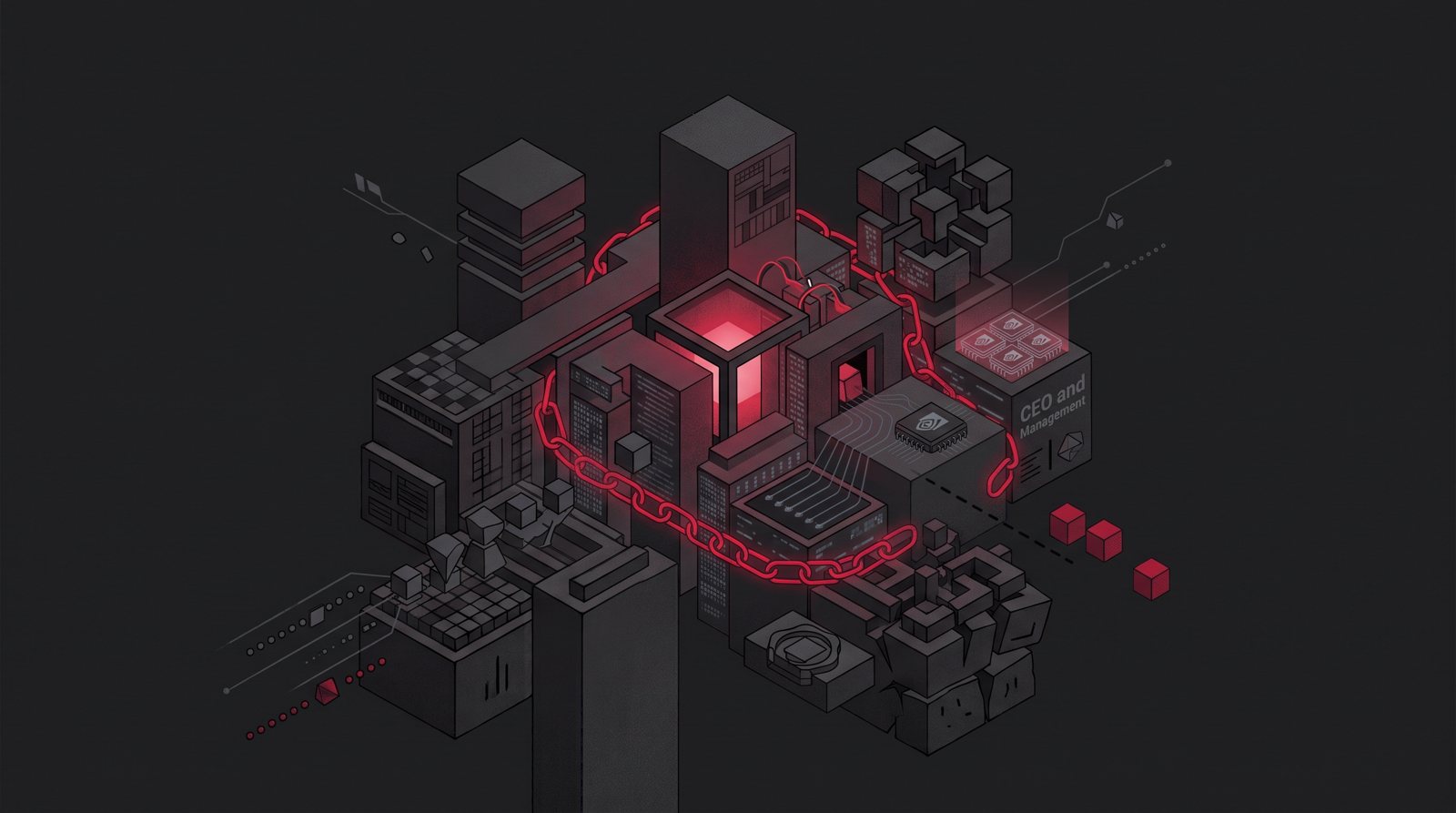
NVIDIA is paying $12 billion to absorb Poolside's team and technology, structuring the deal as a reverse execuhire that sends roughly $1 billion to the startup's founders and $6 billion to its employees. The rest of the transaction ties into infrastructure: a neocloud partner is scaling capacity to 7 gigawatts as part of the arrangement, linking Poolside's coding-model work directly into NVIDIA's compute supply chain.
The label on the deal matters as much as the number. A standard acquihire buys a small team cheap and folds it quietly into the acquirer's roadmap; this payout is not cheap, and the money flows disproportionately to the people who wrote the code rather than the people who founded the company. Employees are set to collect six times what founders get — a split that runs opposite to how most Silicon Valley cap tables are built, where early equity checks usually capture the largest share of any exit.
According to Latent Space, this is the framing behind the "reverse" in reverse execuhire: NVIDIA isn't just buying a cap table, it's buying a working engineering team and paying that team directly for the privilege.
How the numbers break down
The disclosed structure of the $12 billion deal breaks into three pieces:
- $1 billion — the founders' share of the transaction
- $6 billion — split among Poolside's rank-and-file employees
- 7 GW — the neocloud capacity target an infrastructure partner is scaling as part of the same arrangement
Poolside built its reputation on training large models for code generation, competing in the same lane as Cursor, Cognition, and the coding-focused efforts inside OpenAI and Anthropic. Rather than compete on that roadmap indefinitely, its technology and staff now move inside NVIDIA.
Talent, not equity, is the prize
The employee-heavy payout is the clearest signal of what NVIDIA actually wanted out of this deal. Coding-model research talent is scarce and expensive to recruit individually; buying an entire trained team at once, at a price that keeps them financially motivated to stay, is a faster path to capability than hiring one engineer at a time. The founders' smaller cut, relative to the employee pool, suggests the deal was priced around retaining the workforce rather than rewarding the cap table.
The 7 GW neocloud scale-up folded into the same transaction is worth flagging on its own. It signals NVIDIA isn't treating this as a pure talent acquisition — the infrastructure commitment ties Poolside's technology to a specific compute build-out, reinforcing how tightly model development and GPU supply are now bundled together at this scale.
What this means for AI builders
- Independent model startups working on coding or agentic systems are increasingly likely to end up absorbed into a hyperscaler's or chipmaker's org chart rather than staying independent or reaching an IPO.
- Deal structures like this one let large compute owners acquire teams and IP without the friction of a conventional M&A process, and the size of the payout suggests this approach is becoming a standard playbook rather than a one-off.
- Compute capacity and model talent are being priced and packaged together — a reminder that betting on a coding-model vendor also means betting on whoever eventually controls its infrastructure.
AiiN's takeaway
This deal is another data point in a pattern that keeps repeating: capital in AI infrastructure keeps concentrating around a handful of players, with NVIDIA sitting at the center of nearly every path. Teams building on top of coding assistants, agentic tooling, or any vendor whose technology depends on large-scale GPU access should treat NVIDIA-ecosystem dependency as a long-term planning variable, not a footnote. In our estimation, the size of this payout also raises the bar for what counts as a competitive offer when hyperscalers go after AI research teams next — expect similarly structured deals to become more common, not less.