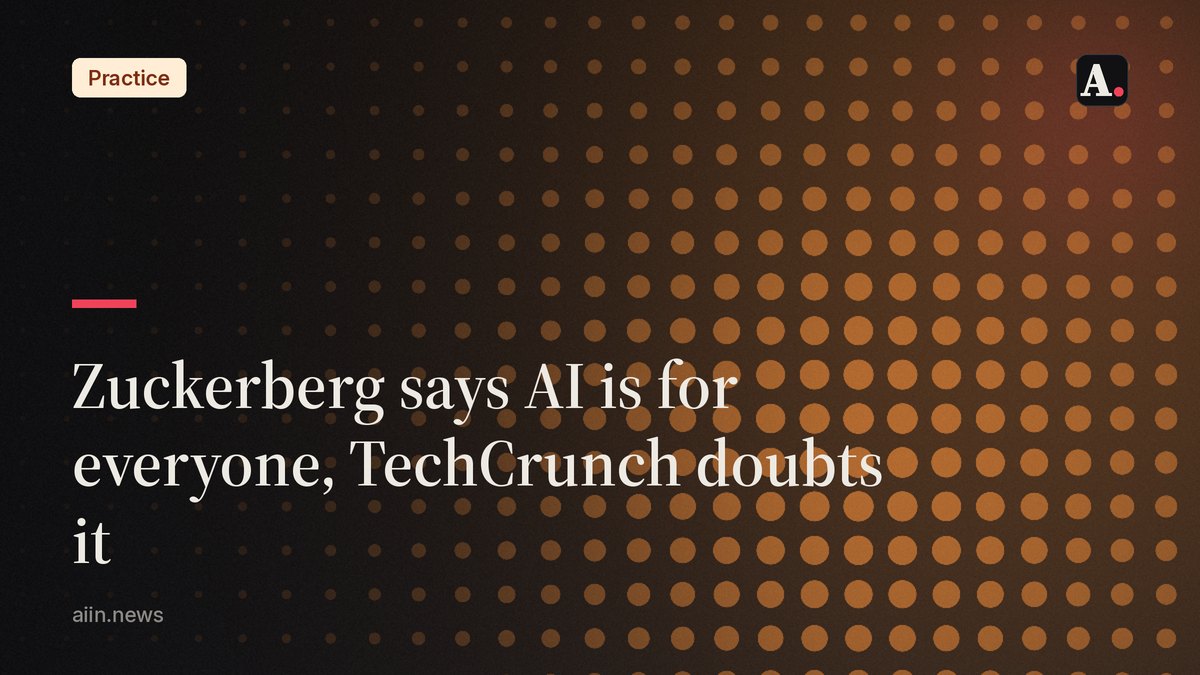
Meta went on TechCrunch's podcast this week to make its case for open AI once more, arguing that handing developers direct access to its model weights and tooling — rather than gating everything behind a paid API — is the smarter long-term bet for winning the AI platform war.
The strategy is not new; Meta has shipped its Llama models as open-weight releases since 2023, breaking from the closed, API-first playbook that OpenAI, Anthropic, and Google have largely stuck to. What stood out in this conversation was the framing: Meta cast open access less as a philosophical stance and more as a deliberate wedge for developer mindshare against closed competitors.
According to TechCrunch, the same episode also dug into a $250 million deal that went sideways — a detail that says as much about the current AI market as the open-source pitch itself: money is moving fast, and not every bet is paying off.
Why Meta is leaning harder into open
Meta's argument, as relayed on the podcast, boils down to distribution. A model that any developer, startup, or enterprise can download, fine-tune, and self-host builds a dependency the vendor doesn't have to pay for with API margin. Every fine-tuned Llama deployment, every open-source tool built on top of it, extends Meta's footprint into products the company itself never has to build. It's the same logic Google used with Android and Kubernetes: give away the substrate, own the ecosystem around it. It also lowers the barrier for enterprises wary of sending proprietary data to a third-party API — a concern that keeps coming up whenever a large company evaluates AI vendors for regulated workloads.
What builders actually get
- Model weights they can run on their own infrastructure, without per-token API costs or a third party sitting between them and their users' data.
- The ability to fine-tune and modify the model for a narrow use case instead of prompt-engineering around a closed model's fixed behavior.
- No dependency on a single vendor's uptime, rate limits, or pricing changes — a real concern after multiple API providers have raised prices or throttled access this year.
- A larger open-source ecosystem of fine-tunes, adapters, and inference tools built by the community around Llama, which shortens the path from prototype to production for niche use cases.
For teams building products where inference cost or data residency is a hard constraint — regulated industries, on-device apps, high-volume pipelines — that combination is often more decisive than raw benchmark scores.
The catch: open weights aren't free
Open access shifts cost, it doesn't eliminate it. Running and fine-tuning a large model in-house requires GPU capacity, MLOps expertise, and ongoing maintenance that a hosted API quietly absorbs. Licensing terms also matter: Meta's open releases have come with usage restrictions for very large companies in the past, so builders still need to read the fine print rather than assume "open" means "unrestricted." There's also a governance angle: security and compliance teams still need to vet a self-hosted open-weight deployment the same way they'd vet any other piece of infrastructure, since the vendor is no longer patching or monitoring it for them. In our estimation, the strategy works best for teams with real infrastructure, not solo developers chasing the lowest sticker price.
AiiN's takeaway
The practical move for builders isn't to pick a side in the open-versus-closed debate — it's to treat model choice as an infrastructure decision, not a branding one. Prototype fast on whichever API is most convenient, but keep an open-weight fallback in the design if cost, latency, or data control could become a constraint at scale. Meta's continued push toward open access, paired with the reminder that AI deals can still go badly wrong, is a signal that the market is far from settled — optionality is worth more right now than loyalty to any single provider. For AiiN's readers building AI products, the practical checklist is short: know your inference cost curve, know your data-residency requirements, and know how quickly you'd need to switch models if a vendor changes terms.