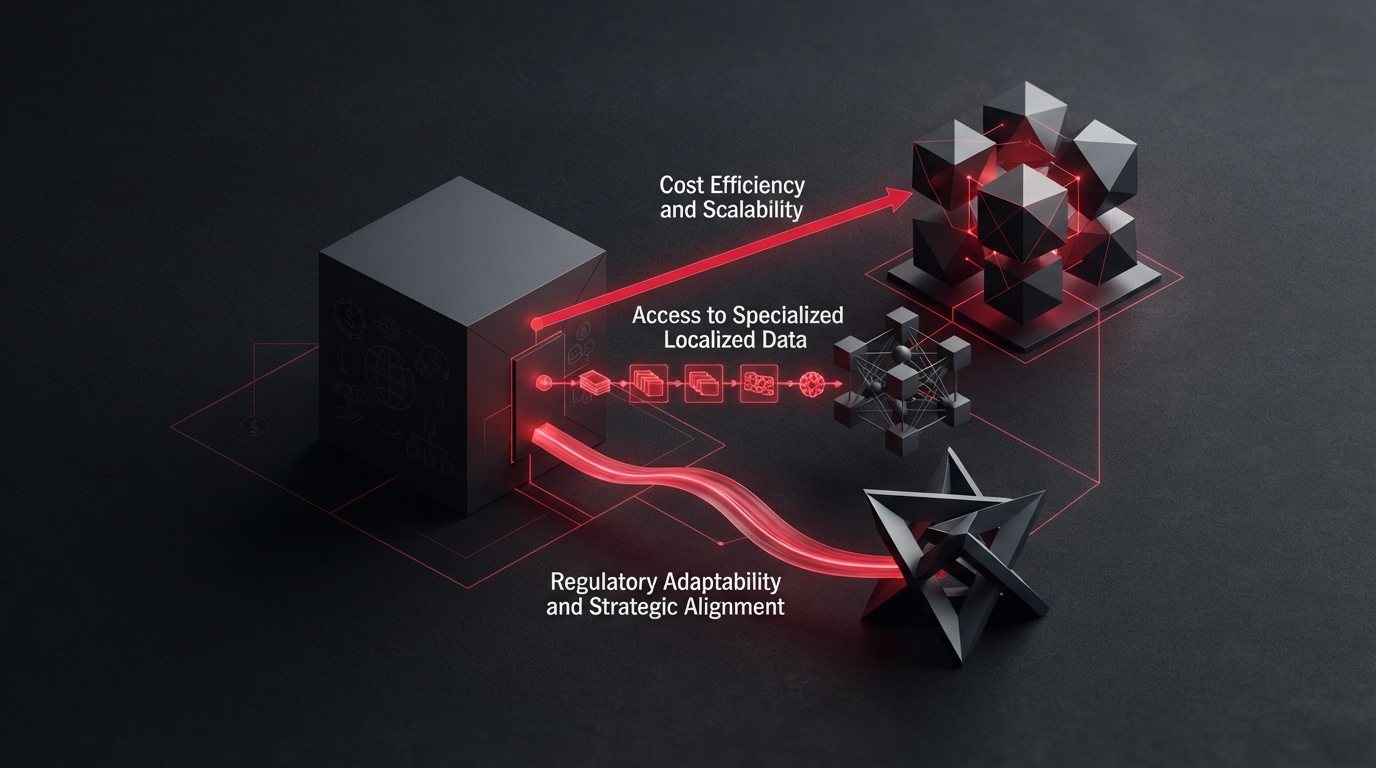
DeepSeek's R1 release in January 2025 didn't just spook Nvidia's stock price for a day — it set off eighteen months of Chinese labs racing to prove that frontier-grade AI doesn't require frontier-grade pricing. Alibaba's Qwen family, Moonshot AI's Kimi, and Zhipu's GLM models have followed with open weights, aggressive API pricing, and benchmark scores that increasingly sit within striking distance of GPT and Claude-class systems. According to Techmeme, citing Bloomberg's latest analysis, that combination is now doing something more consequential than winning headlines: it's pulling enterprise buyers away from US API providers on cost grounds alone, even when the quality delta is negligible.
For most of the past three years, the AI procurement conversation inside companies was simple: OpenAI or Anthropic for anything customer-facing, open-source as a hobby project for cost-sensitive teams. Bloomberg's reporting suggests that split is eroding — not because Chinese models have leapfrogged the US frontier, but because "good enough" now costs a fraction of what it used to, and finance teams notice.
Why price is winning the argument
The technical story matters less here than the commercial one. Model quality across the top handful of Chinese and American labs has converged enough that, for a large share of production workloads — summarization, classification, RAG retrieval, structured extraction, customer support triage — the marginal quality gap between a leading Chinese model and a leading US model doesn't justify a multi-times price premium. That's the calculus Bloomberg describes: businesses aren't choosing Chinese models because they're better, they're choosing them because the cost-per-token math no longer favors the incumbents by default.
This is a familiar pattern from cloud infrastructure and commodity hardware: once a capability stops being differentiated, price becomes the deciding variable. The signal worth watching isn't a single benchmark win — it's procurement teams treating model choice as a line-item cost decision rather than a strategic bet on one vendor's roadmap.
What's actually shifting inside companies
- Teams are running side-by-side evals on production traffic rather than trusting published leaderboards, and finding smaller gaps than expected on non-frontier tasks.
- Chinese providers' open-weight releases make self-hosting a real option, which caps what any provider — Chinese or American — can charge before a company just runs the model itself.
- Procurement conversations increasingly start with a cost ceiling, then work backward to which models clear the quality bar, rather than starting with a preferred vendor.
None of this means US labs are losing the frontier. GPT-5-class and Claude-class models still lead on the hardest reasoning and agentic tasks, and that gap is real. What's changed is that fewer workloads actually require frontier capability, and Chinese providers have gotten good at serving the ones that don't — cheaply.
Practical implications for AI builders
If Bloomberg's read is right, the strategic response isn't "switch to Chinese models" — it's "stop assuming a single-vendor architecture is safe." A few concrete moves follow from that:
- Abstract the model layer. Route through a gateway or interface that lets you swap providers per-task without rewriting application code — this is the difference between a cost optimization and a migration project.
- Benchmark on your own workload, not public leaderboards. The gap that matters is the one on your prompts and your data, not MMLU or a coding leaderboard.
- Segment by task, not by vendor loyalty. Reserve frontier US models for the reasoning-heavy, high-stakes calls; route high-volume, lower-stakes traffic to whichever model clears the bar at the lowest cost.
- Watch data residency and compliance constraints separately from cost. Cheaper isn't automatically deployable — regulated industries and government-adjacent customers will keep constraints that price alone doesn't solve.
The teams that get burned here are the ones that hardcoded a single provider's SDK and prompt format two years ago and never revisited it. Multivendor isn't a nice-to-have anymore; it's the difference between capturing a price drop in a quarter and capturing it in a year, after a rebuild.
AiiN's takeaway
A real alternative to US API providers is forming, and it's forming on price first, capability second — which is exactly the order that tends to reshape markets fastest. In our estimation, the practical move for product teams isn't picking a side in the US-China model race; it's making sure your architecture doesn't force you to. Build the abstraction layer now, while switching costs are low, rather than after a vendor's pricing or availability changes underneath you.