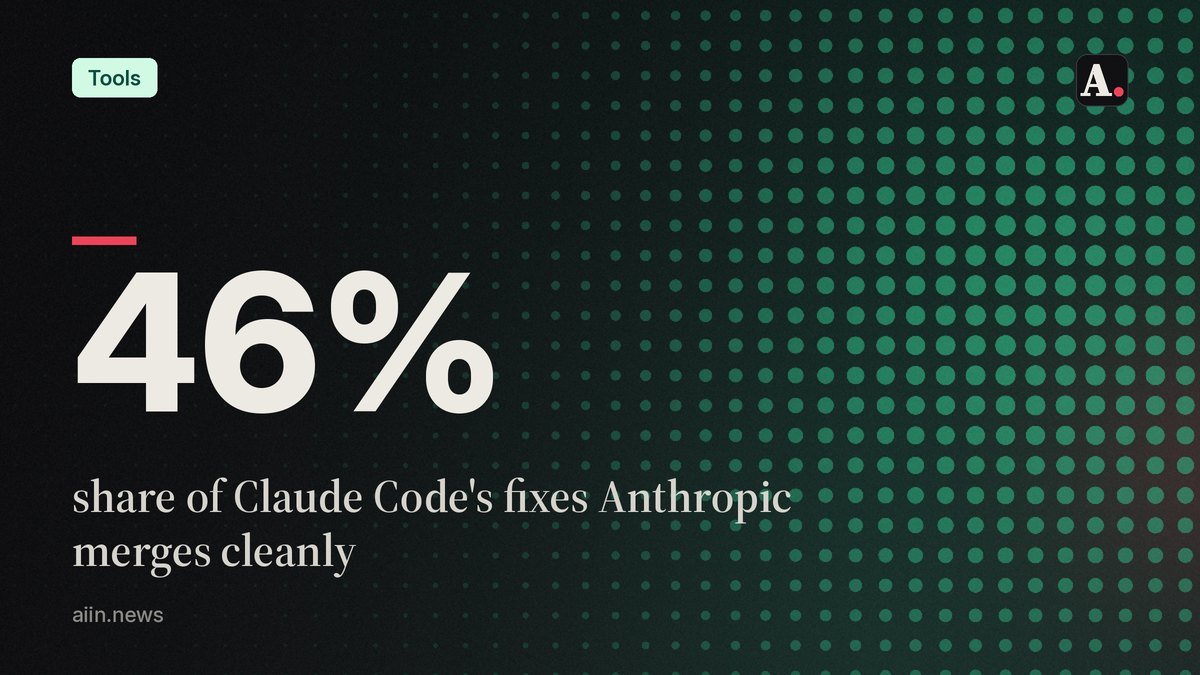
Anthropic has put Claude Code to work maintaining its own software on a daily basis, and only 46 percent of the changes the agent proposes actually get merged, According to The Decoder. That single number is worth sitting with: it comes not from a vendor benchmark or a controlled demo, but from the company that builds Claude running its own agent against its own production code.
For an industry that has spent two years arguing about whether AI coding agents are ready to work unsupervised, a self-reported acceptance rate under 50 percent is a rare piece of ground truth. It does not settle the argument. It reframes it: the question is no longer whether an agent can propose a fix, but how much human judgment still has to sit between "proposed" and "shipped" — even inside the lab that trained the model.
What "daily maintenance" signals
Running an agent once on a hard problem and running it every day on a live codebase are different tests. A single completed task can be cherry-picked, retried, or reviewed at leisure. A daily cadence has no such luxury: the agent keeps proposing changes whether or not a human has time to look closely, and the merge rate becomes a running scorecard rather than a one-off headline. Anthropic putting Claude Code on that kind of standing schedule against its own systems is a statement of confidence in the workflow, even before anyone looks at the acceptance number.
It is also, structurally, the harder use case to sell. Greenfield feature work gets attention and code review because it is new; maintenance work — the unglamorous stream of small fixes, cleanups, and adjustments that keeps a system healthy — usually gets whatever attention is left over. Automating that category is exactly where agentic coding tools are being pitched hardest to engineering teams, which makes Anthropic's own numbers a useful reference point rather than a footnote.
Reading the 46 percent correctly
A merge rate under half is not evidence that the agent is failing at its job — it is evidence that the review gate in front of it is doing its job. Every proposed change still passes through a human or an automated check before it lands, and roughly half of what Claude Code proposes does not survive that check unchanged. That is a strict bar, not a loose one, and it is the bar Anthropic is applying to itself.
What the figure does not tell us — and what The Decoder's report does not specify — is the breakdown behind it: how many proposals are rejected outright versus reworked and merged later, what categories of maintenance work are in scope, or how the rate has moved over time. Builders should treat 46 percent as a headline data point, not a full methodology.
What this means for teams running their own agents
The practical value of this story is less "Anthropic did it" and more "here is a number to benchmark against." Teams piloting agentic coding on their own codebases can use it as a sanity check:
- Track merge rate as a first-class metric, the same way you would track test coverage or deploy frequency — not just whether the agent completed a task, but whether its output survived review unchanged.
- Keep a human or automated gate in the loop by default for anything touching production, especially on a recurring schedule rather than a one-time run.
- Budget review time for roughly half the volume, not the full volume — if Anthropic's own team reworks or rejects around half of what its agent proposes, plan staffing and code-review capacity accordingly rather than assuming near-full automation.
- Separate "agent completed a task" from "agent shipped a fix" in any internal reporting — conflating the two overstates how autonomous the workflow actually is.
AiiN's takeaway
What makes this story notable is not the automation itself — internal dogfooding of coding agents is now standard practice at most AI labs — but the willingness to attach a hard, unflattering-sounding number to it. A 46 percent merge rate does not read like a launch metric; it reads like an honest operational one, and that is precisely what makes it useful. In our estimation, a sub-50 percent rate on a recurring maintenance workload is likely closer to what mature agentic coding looks like in practice than the near-100 percent success claims common in vendor demos. For AI builders evaluating how much autonomy to grant their own coding agents, that is the more instructive signal than the fact that Claude Code runs daily at all.